
Soccer vs American Football Jerseys: What's Different
Cut, collar, sleeves, numbers, fabric and print: how soccer and American football jerseys differ, and why those differences matter when you order kit.
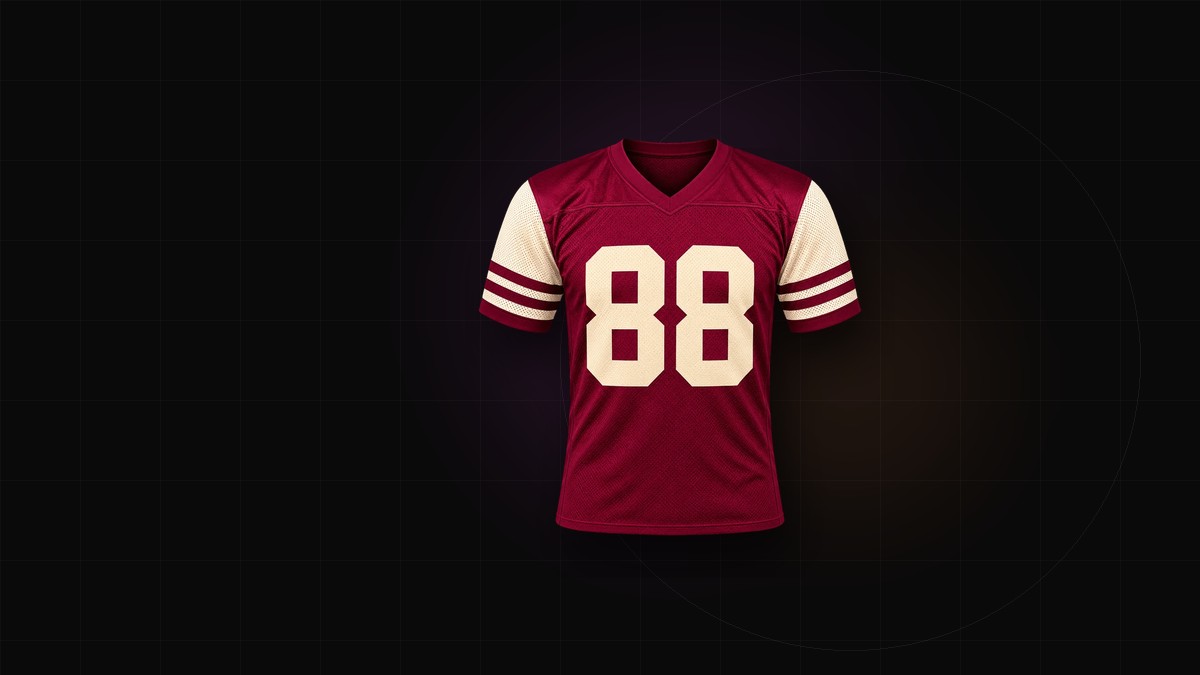
Both sports are called football, and from the back of a stand the shirts look related: short sleeves, a number, a crest on the chest. Up close they are built for different problems. A soccer jersey is made to run in. An American football jersey is made to be grabbed, and to fit over shoulder pads.
If you are designing or ordering kit, those differences decide the template, the print method and the size run. Here is where the two diverge.
They solve different problems
A soccer jersey is the athlete's only upper layer, so it carries the whole job: light weight, fast drying, freedom through the shoulders. An American football jersey is a shell over equipment. It has to survive contact, cover pads, and stay in place while the player is being tackled.
That single difference explains most of what follows.
Cut and fit
- Soccer jerseys are athletic and relatively short. The hem sits near the hip, the waist is tapered, and the shoulder line is narrow. Slim and standard cuts are both common.
- Football jerseys run longer so they can be tucked, with a wider chest and much larger armholes. The body has to clear shoulder pads without pulling across the back.
- Sizing works differently. Soccer sizes are usually S-3XL. Football jerseys are often sold in even chest sizes such as 44, 48 or 52, measured to fit over pads. Ordering a football jersey in your T-shirt size is a reliable way to get the wrong shirt.
A pattern that looks right on one template will not simply scale onto the other. Side seams, shoulder seams and the armhole curve all sit in different places, which matters later at the print stage.
Collars and necklines
Soccer gives you a real design decision: crew neck, V-neck, or a retro polo collar with a placket. Trim on the collar is one of the cheapest ways to make a kit look considered.
American football collars are more utilitarian. They are usually a reinforced crew or a shallow V, cut wide enough to pull over pads when dressing. Buttons and polo plackets are rare, and the neckline is not where the design lives. Budget your detail elsewhere.
Sleeves
Soccer sleeves are set-in or raglan, hemmed, and often carry trim or a small flag. The sleeve is part of the silhouette, and on raglan templates the seam becomes a design line you can use.
Football sleeves are short and wide, sometimes elasticated or banded at the cuff, shaped around the pad cap. On some templates the sleeve is barely more than a cap. Television numbers, where a league or program uses them, sit on the shoulder or upper sleeve, and they need to fit inside the panel rather than straddle a seam.
Numbers and lettering
Soccer numbering is fairly free. A back number of roughly 25-30 cm, a front number of 15-20 cm and a name above the back number is the convention. Type is often sublimated with the rest of the shirt.
American football puts numbers on the front, the back and often the shoulders, plus a nameplate. At higher levels they are frequently sewn tackle twill; printed numbers appear more at youth and recreational levels. Many programs also tie numbers to positions, and professional rules have loosened in recent seasons, but the ranges vary by level, so check the rulebook your team plays under.
The layout consequence is simple: football number placement is constrained by seams, panels and rules. Soccer gives you more room, but the back panel still has to fit the largest two-digit number on the roster.
Fabric and construction
Soccer jerseys use lightweight polyester knits, jacquard or mesh panels, and increasingly recycled yarn. The surface is smooth enough for all-over sublimation, and the fabric weight is chosen for heat and movement.
Football jerseys use a heavier mesh body with solid, abrasion-resistant shoulder panels and stretch side panels. The construction is built around contact and equipment, not around airflow alone.
Weight changes print behaviour. Fine lines, small type and subtle gradients hold up on a smooth soccer knit. On a textured football mesh they can break up, especially at arm's length.
What this means for print
- All-over sublimation suits soccer templates. On football jerseys the shoulder panels, armholes and side seams cut through artwork, so design each panel deliberately.
- Tackle twill and heat transfer suit football numbers and nameplates, but they limit colour blending and fine detail.
- Check the mirror. Some sublimation workflows print the transfer in mirror image and some expect a pre-mirrored file. Confirm with your printer; a mistake here turns names and numbers backwards.
- Keep detail off the seams. A stripe meant to run continuously from body to sleeve needs to be adjusted at the seam, or it will jog.
What carries over
The fundamentals do not change. Both shirts are read from twenty metres away, so contrast and number legibility matter more than ornament. Both need a colour system with clear jobs, and both should be proofed at production size before the order is placed.
If you are building a soccer kit, start in the soccer jersey generator. For the padded game, the football jersey generator uses a template built for pads. Number and name type can be set either way in the jersey font generator.