
Basketball Jersey Number Rules by League
How basketball jersey numbering works across FIBA, NCAA, the NBA, NFHS high school rules and youth leagues, plus what designers check before printing.
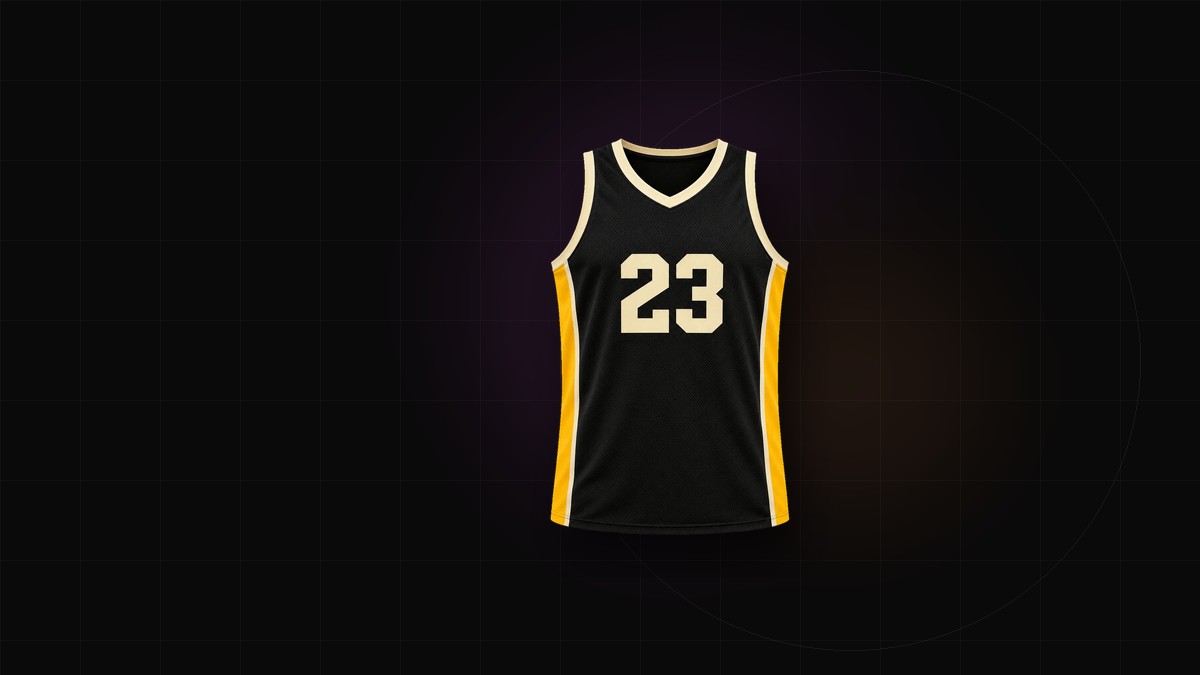
Jersey numbers look like a design decision. In basketball they are also a rulebook decision, and the rulebook differs by league, by country and by age group.
Rulebooks are revised, sometimes quietly. What follows is the general pattern, not a citation. Before you print a team set, read the current rulebook for your league and confirm the numbers with the officials or the scorer.
Why basketball numbers are regulated
Basketball numbers exist to be communicated. Referees report fouls by signalling the number to the scorer's table, and the traditional method uses the fingers of one hand for each digit. That is the reason the old digit restriction existed: numbers were built from digits 0 to 5, producing the familiar 0-5, 10-15, 20-25 and so on up to 55.
The game has moved on, but the principle has not. A number has to be unambiguous when it is spoken, written on a scoresheet, entered into software and read from the other end of the court.
The general pattern
Most current rule sets allow numbers from 0 to 99. That is two digits, each from 0 to 9, and it gives a roster far more room than the old 0-5 system.
Two details vary:
- Whether 00 is allowed, and whether it is treated as separate from 0.
- Whether the league narrows the range for scorekeeping, age or local rules.
That is where you need the actual rulebook, not a summary.
League by league, in general terms
- FIBA: current FIBA rules allow numbers 0-99.
- NCAA: men's and women's rules allow 0-99. Check the current NCAA rule book for how 00 is handled.
- NBA: numbers 0-99, with 00 permitted as its own number.
- NFHS (US high schools): national rules allow 0-99, but state associations can add their own requirements, so check your state's handbook as well as the national rule.
- Youth and recreational leagues: often narrower. Some restrict the range so a volunteer scorer or a simple scoreboard can handle it, and 1-15 is a common convention. League bylaws decide this, not habit.
None of these ranges overrides a team or school policy on retired numbers. A program may have numbers it does not issue, and that reduces the pool before the rulebook is even applied.
Zero and double zero
In leagues that permit both, 0 and 00 are different numbers and should not appear on the same roster. Some scoreboards, roster systems and announcers treat them as interchangeable, which causes confusion in exactly the moment a number matters.
If you are designing for 00, build it as two digits. Some fonts render it tightly or with a slash; check that it reads as "double zero" and not as a smudged single digit at distance.
What this means for your design
Roster math. A 0-99 range gives a hundred options minus retired numbers, which is enough for any normal roster. The constraint is usually policy, not capacity.
Uniqueness. Two players cannot share a number. Keep a roster list, check it before the print order, and plan replacements for lost or damaged shirts.
Number size and contrast. Many rulebooks also set requirements for number height and for contrast with the jersey. Those matter as much as the digits themselves: a legal number in a low-contrast color is still unreadable from the stands.
Digit legibility. Some pairs are easy to confuse at distance: 1 and 7, 6 and 9, 8 and 3, 5 and 6, 0 and 8. Choose a font where the differences are structural, not decorative, and check the pairs that appear on your actual roster.
Front and back. Basketball numbers appear on both, and the front number is often smaller and sits inside a narrower panel. Test the widest number you will print, not just a single digit.
Number fonts and legibility
Block and varsity faces remain the safest choice for basketball. The number is read at speed, from the bench, the stands and the broadcast camera, and thin strokes or script connections disappear at distance.
If you use an outline or drop shadow, keep the counters open in 0, 6, 8 and 9. A closed counter turns an eight into a blob.
The jersey font generator lets you preview names and numbers in place before you commit to a typeface. Once the numbering is set, build the rest of the kit in the basketball jersey generator.
A checklist before printing
- Read the current rulebook for your league, and your state or school handbook if you have one.
- Confirm whether 00 is allowed and how it is scored.
- Collect retired numbers and team policy restrictions.
- Assign numbers from a single roster list and check for duplicates.
- Check minimum number size and contrast requirements.
- Test the font against the digit pairs on your roster.
- Proof at production size, then order.
The rulebook decides what is legal. The design decides whether anyone can read it. Both have to be right before the shirts go to print.